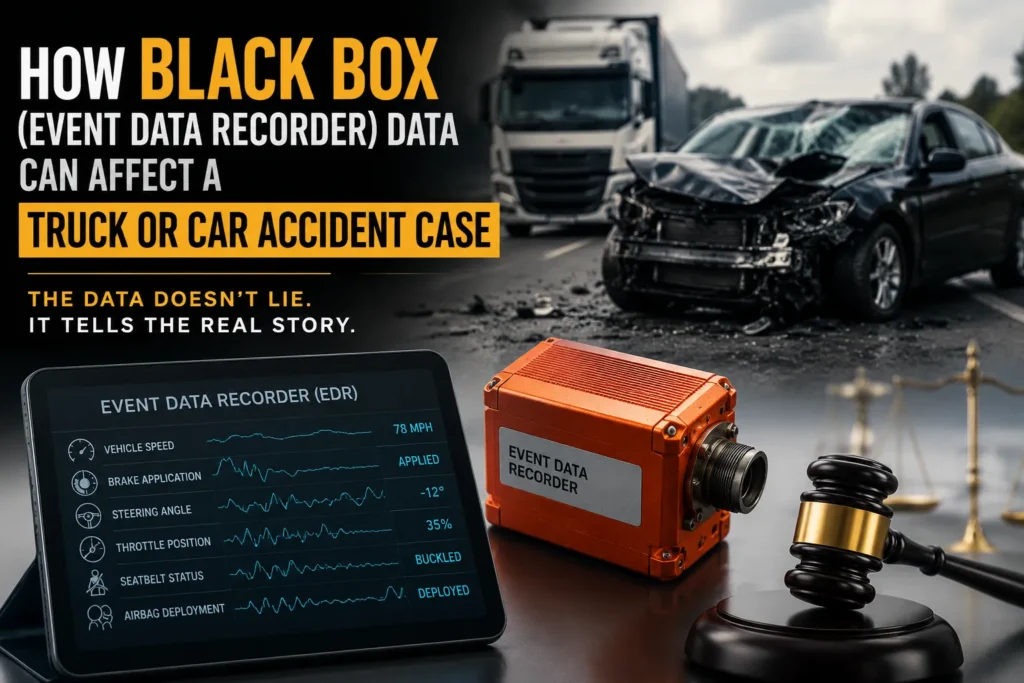
When the accident scene is cleared, the only thing left is the word of the driver against the word of the victim. The trucking company sends its own investigators within hours, and they start building a story to protect themselves.
But the vehicle black box data does not lie. It doesn’t depend on human recollection. Instead, it records critical vehicle data and provides an objective, data-driven account of what occurred in the moments leading up to the crash. And that can change everything.
Think about it. A driver says they were obeying the speed limit. But the data shows they were doing 78 in a 60 zone. Guess who’s telling the truth? The black box.
That kind of car accident investigation can make or break a case. It can be the difference between a claim getting denied and victims finally getting the justice they deserve after an accident reconstruction.
What Is an Event Data Recorder?
An event data recorder is basically your vehicle’s “black box.” Same idea as the ones on airplanes, but way smaller. It’s hooked up to sensors all over the car or truck, things like speed, braking, and steering. And it’s always watching. Always recording.
When something happens, a crash, a hard stop, a sudden swerve, it kicks in automatically. It saves the data from a few seconds before the event and a few seconds after. Just enough to tell the story of what really went down.
Now, for commercial trucks, it’s usually built right into the Engine Control Module – the ECM. That data gives a really clear picture of how the truck was performing right before, during, and right after a crash.
Event Data Recorder vs. Electronic Logging Device: What’s the Difference?
The event data recorder gives you the “micro-view.” It tells you exactly what went down in those critical seconds right before, during, and after the crash. Speed, braking, steering, seatbelt use, airbag deployment all of it’s right there.
Now, an ELD that’s an Electronic Logging Device gives you the “macro-view.” It tracks the driver’s hours on the road, GPS location history, and duty status. Basically, it shows the big picture. This data can prove a driver was exhausted, running on no sleep, or violating federal hours-of-service rules. And that gives you the context, the why behind the crash.
What Data Does an Event Data Recorder Capture?
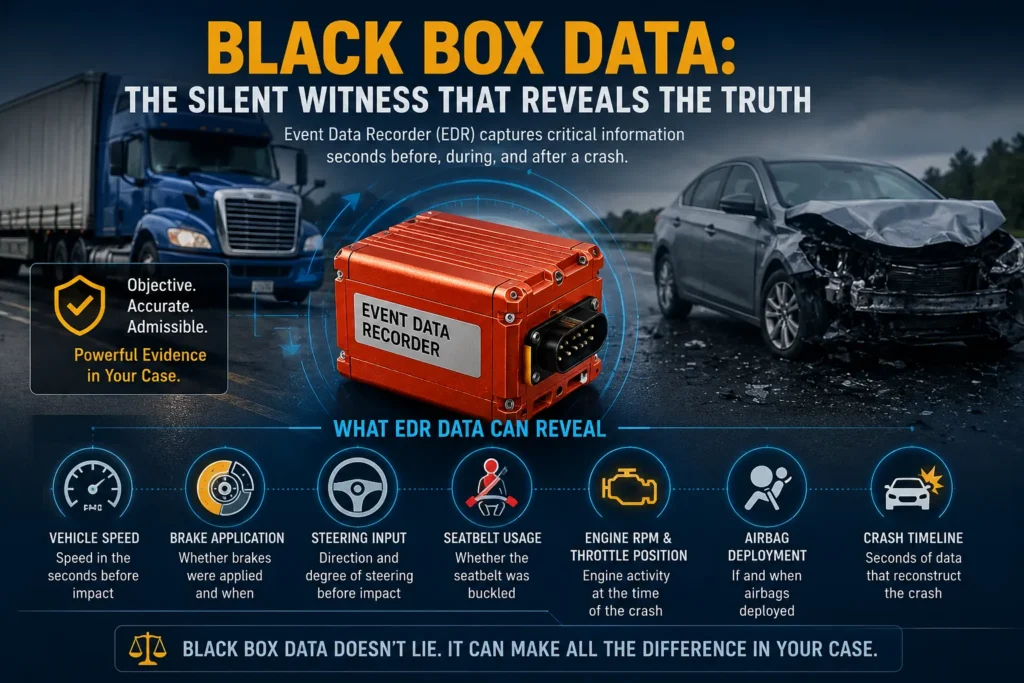
It captures a wide range of data points, each offering unique insights into the dynamics of a crash.
- Vehicle Speed: The EDR logs the vehicle’s speed in the seconds before impact.
- Brake Application: The EDR records the exact moment the brakes were applied—or if they were applied at all.
- Steering Input: The EDR records steering angle, helping reconstruct whether the driver attempted evasive maneuvers.
- Seatbelt Usage: The EDR notes whether the driver’s seatbelt was buckled.
- Engine RPM and Throttle Position: This data shows what the engine was doing at the moment of the crash .
- Airbag Deployment: The EDR records if and when airbags deployed.
When these data points are combined, they create a complete picture of what occurred before and during the crash.
How Data Recorder Proves Fault
Speeding. It shows truck accident investigations that he was traveling 78 mph in a 60 mph zone, the driver’s claim of obeying the speed limit is disproven . Failure to Brake. It shows brakes were never applied and can expose driver distraction, fatigue, or mechanical failure.
Hours-of-Service Violations. When combined with ELD data, the event data recorder can help prove driver fatigue and regulatory violations . Fault codes saved can show a trucking company ignored maintenance needs.
Act Fast: Preserving Recorder Evidence
Here is the most critical point. This data is not permanent. Trucking companies are legally required to preserve it, but they may be tempted to let it be overwritten . it can be overwritten by subsequent driving or deliberate action.
Victims must send a spoliation letter immediately after the crash, formally demanding that the trucking company preserve all data . In one case, a New York court ordered information before a wrongful death lawsuit could even be filed, recognizing the data as “critical evidence”.
Conclusion
It’s a silent, unbiased witness. Doesn’t take sides. Don’t get confused. It just tells the truth. And that truth can turn a messy “he said, she said” dispute into cold, hard scientific fact. It can prove someone was speeding. It can show they never even hit the brakes. And in trucking cases? It can expose negligence by the company itself.
If you or someone you love has been in a serious accident, don’t wait. That data doesn’t stick around forever. Act fast to preserve it – before it’s gone.
Frequently Asked Questions
What’s the difference between an event data recorder and a car black box?
They’re the same thing. Event data recorder is just the technical name for what everyone calls a “black box.” Both mean the device that records data in the seconds before and after a crash.
How long does it take to access data recorder data?
It can be pretty quick if the vehicle is still in your possession. Forensic engineers have special tools to download the data. But you should act fast, if you wait too long, that data can get overwritten and lost forever.
Can event data recorder data be used in court?
Yes, absolutely. Courts have accepted EDR data as key evidence in accident cases. But here’s the catch, the data has to be properly preserved with a clear chain of custody. You gotta prove it hasn’t been messed with.
Who owns the event data recorder data?
In a lot of states, the vehicle owner owns the data. But law enforcement can get it with a warrant. Courts can order it. And it can be obtained through civil discovery. If you’re a victim, get legal help to secure that evidence.
What happens if a trucking company destroys event data recorder data?
That’s a big deal. If they destroy or fail to preserve EDR evidence after being put on notice, they can face spoliation sanctions. That means fines, penalties, or even a presumption that the destroyed evidence would have hurt their case.
Does a civilian car have an event data recorder?
Yeah, a lot of modern cars have them. They record stuff like speed, braking, and airbag deployment. The data can be retrieved and used in investigations. But the features vary by make and model.
How reliable is event data recorder data?
Generally, it’s highly accurate. It uses calibrated sensors and precise recording mechanisms. But like anything, sensor quality and environmental conditions can sometimes affect reliability. Still, it’s one of the best pieces of evidence you can get.